- Air Peace strengthens leadership pipeline with key flight operations appointments
- Transport Summit Holds Friday
- What Abuja private jet door blowout reveals about aviation safety
- Jet fuel price volatility threatens supply companies' viability, warns CITA Energies Chief
- FAAN MD: Financing talks for Lagos airport rail extension reach advanced stage



NAMA deploys mobile control tower at MMIA, plans new CoS for staff
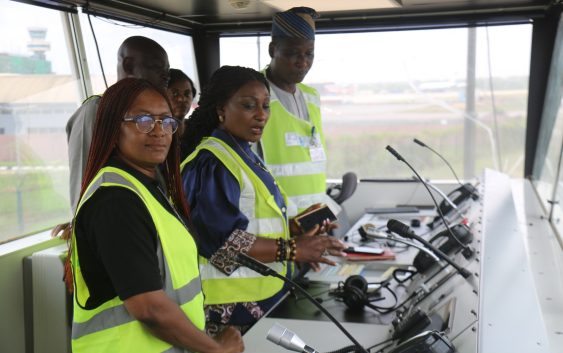
The Nigerian Airspace Management Agency (NAMA) has deployed a mobile control tower at the Murtala Muhammed International Airport (MMIA) in Lagos.
The deployment follows a period of temporary operations after a major fire on February 23, 2026, which gutted the old terminal (Terminal 1) and severely damaged the main aerodrome control tower’s air-to-ground communication equipment.

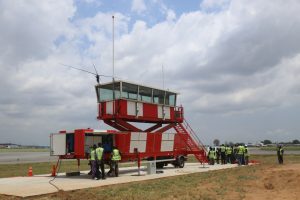
The mobile tower is fully positioned and has undergone successful test runs. Air traffic controllers are prepared to begin full operations from the unit immediately.
While NAMA Managing Director Farouk Umar initially hoped for a February 27 deployment, technical requirements led to a three-week wait.
The agency and its contractor, CCECC, mandated a 21-day curing period for the concrete foundation to ensure the tower’s structural stability and optimal visibility of the runways and taxiways.
During the transition, air traffic services remained uninterrupted. Controllers utilised the Fire Service Tower as a temporary base, supported by backup facilities moved from other stations.
The mobile tower is not just a visual post; it is a sophisticated temporary hub designed to bridge the gap while the main tower’s being restored.
It includes full air-to-ground connectivity to replace what was lost in the fire, antennae and sensors that feed real-time atmospheric data from the Nigerian Meteorological Agency (NiMet) directly to controllers.
The Aeronautical Fixed Telecommunication Network has also been fully restored to ensure the exchange of safety-critical text messages between airports.
Speaking during the on-site inspection of the facility, the Director of Safety Electronics and Engineering Services, Engr. Terese Ihenacho noted that the deployment marked a significant operational milestone, highlighting NAMA’s resilience and unwavering commitment to ensuring the continuity of safe, efficient air navigation services at Nigeria’s busiest aviation hub.
She commended the dedication and technical expertise of NAMA personnel, whose efforts ensured the tower’s timely delivery and operational readiness.
“As you can see, the Mobile Tower is fully operational and serviceable. All necessary test runs have been successfully completed, and air traffic controllers are ready to commence operations at any moment,” she said.
Ihenacho further revealed that the Control Tower has been reconfigured to meet Nigeria’s unique operational demands, incorporating local innovations that enhance efficiency and safety.
Notably, the integration of a smart strip system alongside the traditional manual strip reflects a forward-looking approach to modern air traffic management.
“The way it was manufactured is not the way we are using it. We have restructured it to suit our local peculiarities. There is now seamless connectivity to Centrex and TRACON, which did not exist before. This is part of our innovation to meet global standards,” she stated.
She clarified that deploying the mobile tower is part of NAMA’s broader contingency and resilience strategy, originally conceived as a backup to mitigate potential disruptions from infrastructure upgrades or environmental constraints affecting the main control tower.
Beyond technical deployment, the agency has also implemented critical support infrastructure at the site, including enhanced solar-powered lighting, reinforced structural bracing to withstand environmental conditions, additional power supply systems, and comprehensive security with CCTV surveillance.
Ihenacho also highlighted ongoing efforts to improve the welfare and working conditions of air traffic controllers and technical staff operating at the temporary facility, noting that discussions are underway with relevant authorities to provide essential amenities and support services.

She commended the extraordinary commitment of NAMA staff, describing them as “heroes” who worked tirelessly under challenging conditions, often at personal risk, to restore operational stability, and stressed that the successful deployment of the Mobile Control Tower highlights the agency’s unwavering dedication to the safety and efficiency of Nigerian airspace.
